
— Gerald A. McGill
In November 1961, the United States Joint Chiefs of Staff had directed Commander-in-Chief, Pacific (CINCPAC) to look into the South Vietnamese Navy’s poor performance against enemy infiltration into South Vietnam. CINCPAC, heading up the review team, wanted a Coast Guard perspective.
Commander John B. Speaker, Jr. from Coast Guard Headquarters in Washington D.C. landed in Saigon on 10 November 1961. His blunt report to the U.S. Coast Guard Commandant was very unfavorable of the South Vietnamese Navy. He found ship board maintenance extremely poor, the food bad, and ship board drills and training rarely carried out. At any time half the South Vietnamese Sea Force could not get underway because of machinery breakdowns.
Prior to returning to Washington D. C., Cdr. Speaker stopped in Honolulu to tell CINCPAC what the Coast Guard could do to help. One of Speaker’s comments was that if the United States joined in the fighting, Coast Guard cutters were available and were best used in the hands of Coast Guardsmen.
Since the start of fighting in 1960, the U.S. Army in Vietnam contended that most of the supplies reaching the Viet Cong and the North Vietnamese Army in South Vietnam were coming in by sea. The U.S. Navy disagreed on the basis of insufficient evidence. That position changed in February, 1965.
In February, 1965 a U. S. Army helicopter pilot flying a HU-1B Iroquois over Vung Ro Bay near Qui Nhon noticed an “island” moving slowly from one side of the bay to the other. Upon closer observation, he saw the “island” was a carefully camouflaged ship. Air strikes were called in and the vessel was sunk. Intelligence sources determined that ship was North Vietnamese and engaged in supplying enemy forces.
Now the U.S. Navy recognized the need for an effective security and surveillance system. The Navy also recognized that setting up such a system would be a great challenge. South Vietnam has 1200 miles of coastline to patrol and an estimate of 60,000 trawlers, junks and sampans to control.
In March, 1965, the Coastal Surveillance Force was established and began Operation Market Time named after the native boats using the waterways for fishing and marketing. This task force provided for a single command to coordinate sea, air and land units of the U.S. Navy and South Vietnamese naval units.
Very soon the U.S. Navy recognized the need for Coast Guard units to support this mission. On April 29, 1965, President Lyndon Johnson committed to the formation of Coast Guard Squadron One (RON ONE).
Initially 47 officers and 198 enlisted personnel were assigned to RON ONE. On 16 July, Division 12 of RON ONE departed from Subic Bay, Philippines for Da Nang, Republic of Vietnam. It arrived on 20 July 1965 and began its security and surveillance patrols on 21 July 1965.
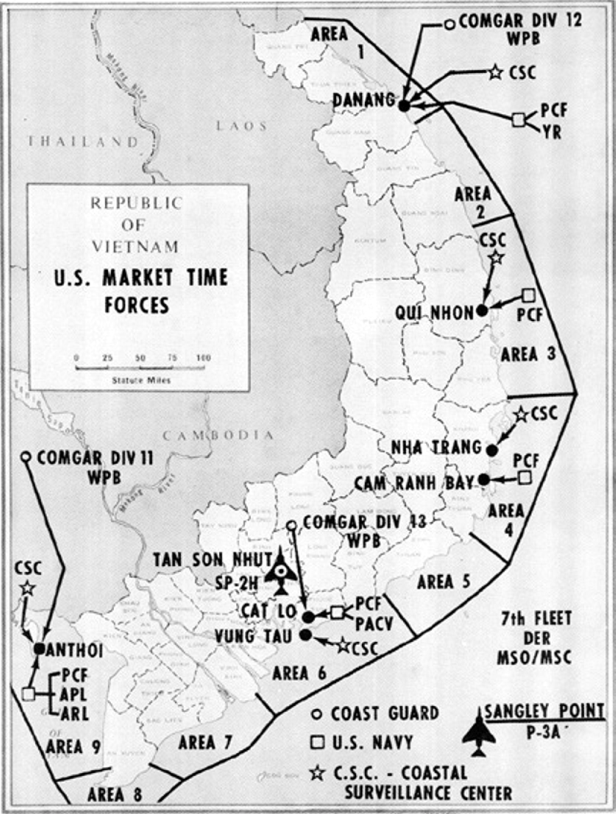
Division 12 consisted of eight 82’ patrol cutters and support staff which had been flown in earlier. The Division 12 patrol areas were from the 17th parallel, which was the Demilitarized Zone (DMZ) separating North from South Vietnam to Qui Nhon approximately 400 miles to the South.
Division 11 patrol areas were from the border of Laos and Cambodia and North Vietnam in the Gulf of Thailand south approximately 400 miles to the mouth of the Mekong River Delta south of Saigon. Division 11 had nine 82’ patrol boats assigned to it.
The Coast Guard’s first combat engagements came on 19 September 1965. At 22:30, near the Cambodian Border in the Gulf of Thailand, the USCGC Point Marone (WPB 82321) closed on a 35 foot junk for boarding. The occupants of the junk responded with small arms fire. When the encounter was over, nine Viet Cong were dead and one critically wounded. There were no Coast Guard casualties.
At a little after midnight, in the same area, the USCGC Point Glover (WPB 82307) ordered a 24 foot motorized junk to stop. The junk reacted by trying to ram the cutter. The cutter dodged the junk and its crew fired into the junk’s engine. When the junk went dead in the water, the five suspected Viet Cong aboard jumped overboard. One was fished from the water by another cutter and taken prisoner. The others either escaped or drowned.
For the first time, since World War II, the Coast Guard was at war again.
 Operation Market Time
Excellent!!
LikeLike